
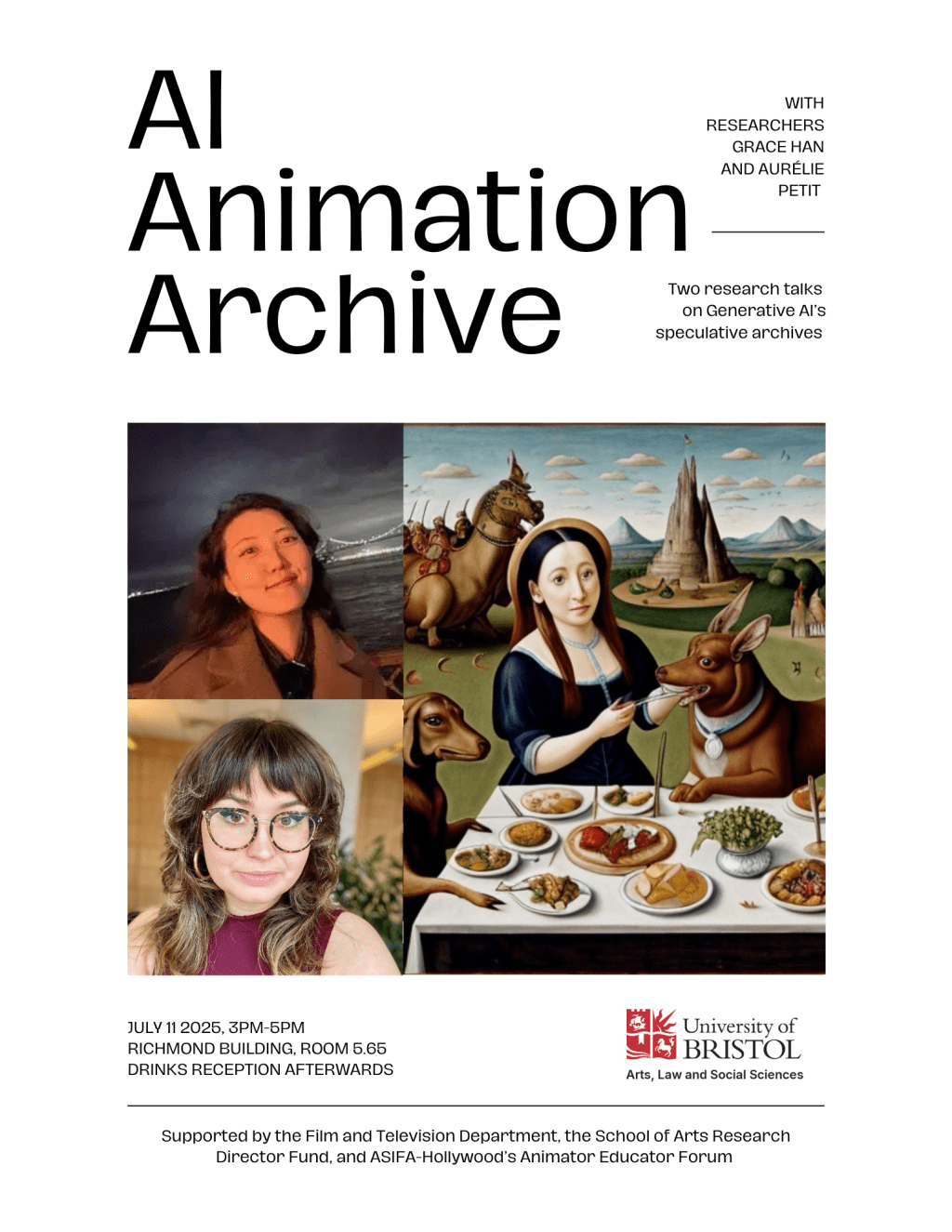
I am pleased to share some of my academic work on the “generative archive” in relation to the art of Heesoo Kwon (who recently exhibited at the 2025 California Biennial — congratulations again, my friend!!) in an upcoming talk at the University of Bristol. Then, Aurélie Petit (Ph.D. candidate, Concordia University) will discuss “Black Pudding: A Speculative Visual Index,” which incorporates generative media to “recover” a lost pornographic archive.
The event will take place on 11 July 2025, from 3pm-5pm BST, in the 5.65 Lecture Theatre, Richmond Building. More details of the event (including both abstracts!) can be found here.
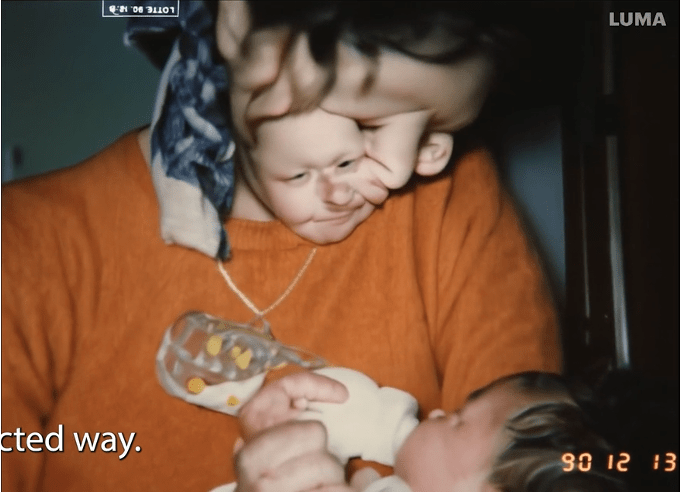
Copying an image of one of the video works I will discuss, and my abstract below. Thanks to Jacqueline Ristola for generously inviting us. It would be great to see some UK friends in Bristol, if possible!
Abstract:
This talk introduces my theory of the “generative archive,” which points out the ways in which artists use generative media (CGI and AI) to “fill in the gaps” of their archives. This talk will begin with a technical explanation of how generative AI derives form from processually generated noise, rather than the indexically recorded trace. Then, through process phenomenology, this talk will explore the relation between generative media, time, and memory.
To ground this discussion, I draw upon a case-study of the computer- and AI-generative feminist archives of Korea-born, San Francisco-based artist, Heesoo Kwon. Kwon inserts CG- and AI-generated renders of her female ancestors to queer her otherwise patrilineal genealogical record. Overall, through this analysis of the generative archive, I respond to the timely question now intensified with the highly-visible digital crisis of fake news, DeepFakes, AI-generative video, and more: How do computers shape, cut, and fit into what we know?

